
Roadmap Presentation: Lessons to Improve Practices of Justice Stakeholders
On this page, you will find (click to jump):
Recording
Biographies

Florian Martin-Bariteau
Dr. Florian Martin-Bariteau is the University Research Chair in Technology and Society at the University of Ottawa, where he is an Associate Professor in the Faculty of Law, Common Law Section as well as the Director of the AI + Society Initiative, and the Director of the Centre for Law, Technology and Society. Dr. Martin-Bariteau is also a Faculty Associate of the Berkman-Klein Center for Internet and Society at Harvard University, as well as a member of the Nexus for Quantum Technologies Institute at the University of Ottawa.

Fabien Gélinas
Professor Fabien Gélinas, Ad. E., teaches and conducts research in the areas of international dispute resolution, common law and civil law contracts, commercial law, law and technology, and legal theory. Formerly General Counsel of the International Court of Arbitration, he acts as arbitrator, expert and consultant on dispute resolution and legal reform.
Professor Gélinas is a cofounder of the Montreal Cyberjustice Laboratory. He has taught at the Centre d’études diplomatiques et stratégiques de Paris (École des hautes études internationales), the Université de Paris II - Panthéon Assas, the National University of Rwanda in Butare, Trinity College Dublin, Sciences Po Paris, New York University and the National University of Singapore.

Jacquie Burkell
Jacquelyn Burkell is a Professor in the Faculty of Information and Media Studies and Associate Vice President, Research, at the University of Western Ontario. Her research focuses on the social impact of technology, examining how technological mediation changes social interaction and information behaviour. She is a co-investigator on the Autonomy Through Cyberjustice SSHRC Partnership grant, and was also a co-investigator on the eQuality Project, a SSHRC Partnership grant focusing on youth equality and privacy online. Her current research focuses on informed consent, and she is a collaborator on a SSHRC Insight Grant focused on challenges to the individual model of consent for the release of personal information. She works collaboratively with colleagues in law, sociology, engineering, and multiple other disciplines. She thrives on the excitement and challenge of interdisciplinary research, and is particularly interested in bringing empirical work from Psychology and Sociology into dialogue with legal and policy issues, in order to inform effective and appropriate responses to some of the challenges of our changing digital environment.

Jane Bailey
Jane Bailey, Full Professor of Law at uOttawa, teaches Cyberfeminism, Technoprudence and Contracts. Her research focuses on technology and human rights, including technology facilitated gender-based violence. She is a co-investigator and co-Team Leader for The Autonomy through Cyberjustice Technologies Project, centred at the Université de Montréal. Together with Dr Jacquelyn Burkell she co-leads The Rethinking Consent Project, a four-year initiative that explores challenges to the individual consent model posed by technologies such as AI and forensic genetics, seeking just publicly accountable alternatives. Jane is also a Research Fellow at the Centre for Protecting Women Online at The Open University in England, and a Faculty Member of the Centre for Law, Technology & Society at the University of Ottawa.

Karim Benyekhlef
Karim Benyekhlef has been a professor in the Faculty of Law at the Université de Montréal since 1989. He has been seconded to the Centre de recherche en droit public since 1990 and served as its Director from 2006 to 2014. He was also the Director of the Regroupement stratégique Droit, changements et gouvernance (Strategic Law, Change and Governance Group), which brings together some 50 researchers, from 2006 to 2014. At the same time, he was the Scientific Director of the Centre d’études et de recherches internationales de l’Université de Montréal (CÉRIUM – the Université de Montréal’s International Research and Study Centre) from 2009 to 2012. He is now the Director of the Cyberjustice Laboratory, which he founded in 2010. The Cyberjustice Laboratory has obtained in 2015 the award «Mérite Innovation» from the Bar of Quebec (Innovation Award). He holds the Chaire de recherche en information juridique Lexum (Lexum Research Chair on Legal Information) and serves as a member of CÉRIUM’s science and advisory committees. He received in 2016 from the Bar of Quebec the distinction Advocatus Emeritus.
Summary
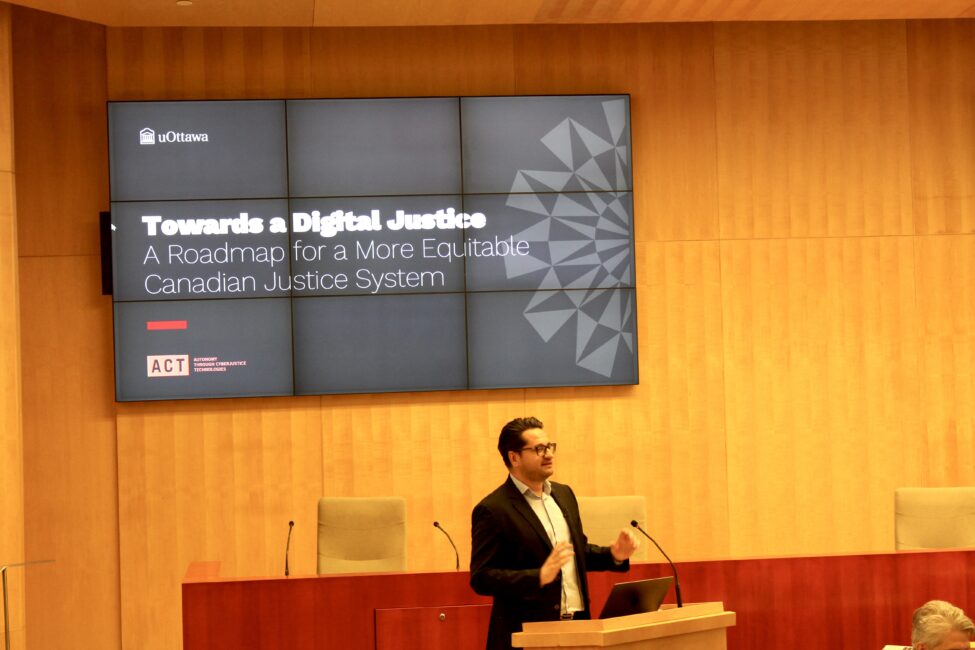
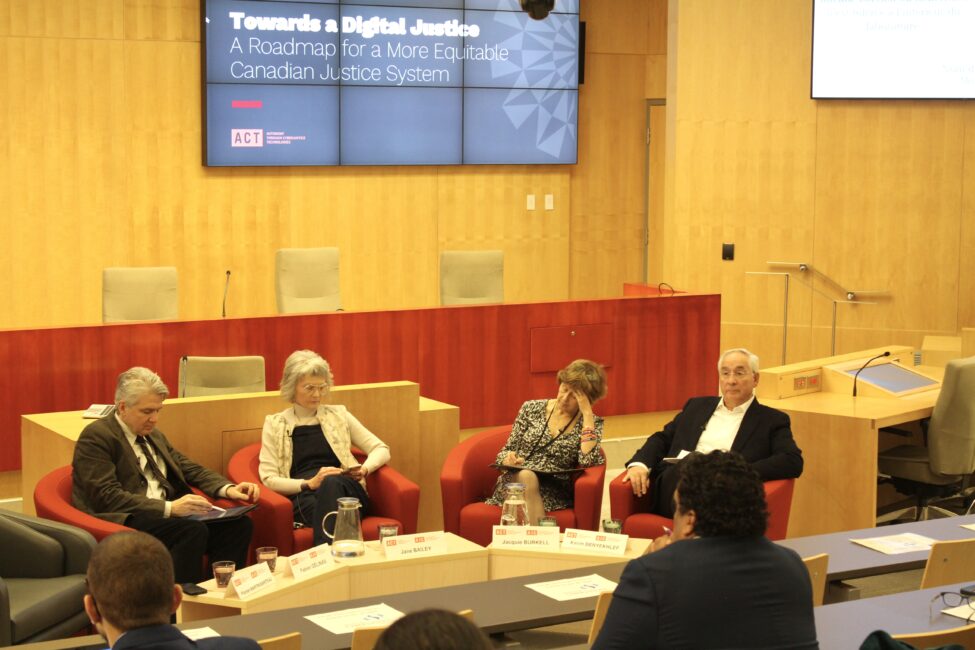
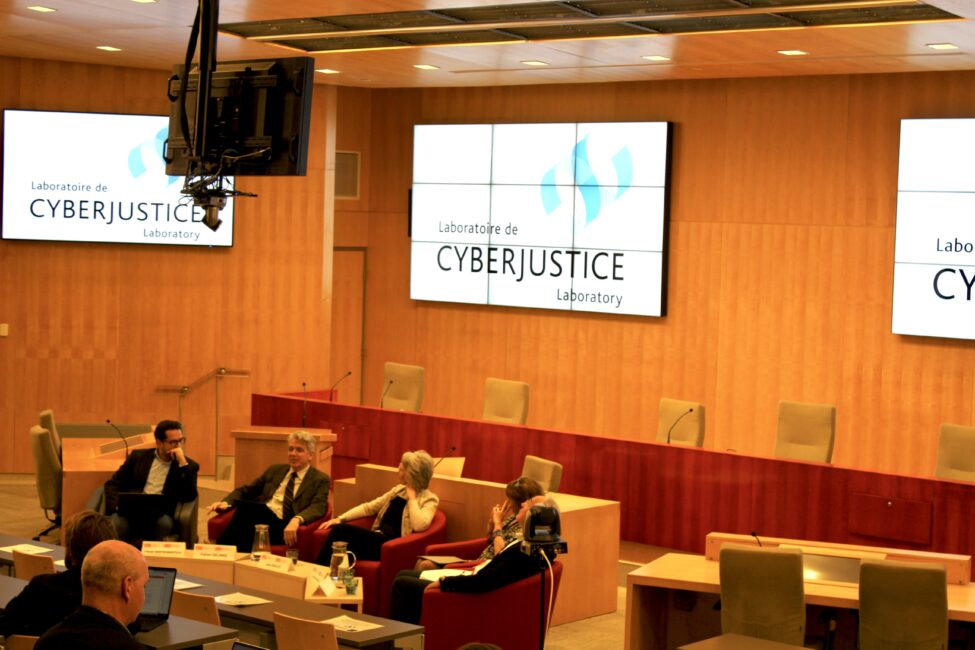
On October 16, 2025, the second day of the conference began with its fourth session. This panel brought together several project leaders from the ACT partnership: Florian Martin-Bariteau from the University of Ottawa, Fabien Gélinas from McGill University, Jane Bailey from the University of Ottawa, Jacquie Burkell from the University of Western Ontario, and Karim Benyekhlef from the University of Montreal, who is leading the project. The presentation focused on the digital transformation of the justice system and proposed a roadmap for improving the practices of judicial actors in Canada, particularly with regard to the integration of technology.
Florian Martin-Bariteau opened the session by presenting the first draft of a report, with the title “Towards a Digital Justice: A Roadmap for a More Equitable Canadian Justice System.” He explained that this report stems from his leadership of Subproject 16 under the ACT initiative, which began in 2018—prior to the COVID-19 pandemic and the rapid emergence of technologies like large language models. He pointed out that the pace of digital transformation in justice has since accelerated, referencing the 2025 UNESCO report that notes 44% of judicial personnel are now using AI tools. Martin-Bariteau’s research incorporated findings from both the ACT project and broader global literature, highlighting specific international experiences such as Brazil’s, where he has been in close contact with several key actors.
The draft report is structured into five major sections. The first section addresses the difficulties associated with accessing judicial data. The second explores the use of digital tools by both litigants and legal professionals, underscoring their increasing adoption and the persistent issue of equitable access. The third section delves into online dispute resolution (ODR), evaluating the contributions of the Cyberjustice Laboratory and public perceptions, which are still mixed regarding whether ODR constitutes legitimate justice. The fourth section examines the digitalization of court systems, including the development of virtual courtrooms and the application of AI technologies, while pointing out inconsistent implementation and the absence of unified guiding principles. The fifth and final section proposes a set of foundational principles for an equitable digital transition in justice. These include ensuring that changes are evidence-based, led by the judiciary, affirm rights, and are centered on users’ needs.
Following Martin-Bariteau’s presentation, Karim Benyekhlef emphasized that the report is a work in progress and forms part of the broader mission of the Cyberjustice Laboratory. He then invited the co-panelists to contribute their perspectives on the issues discussed.
Jacquie Burkell highlighted the critical need for training individuals to interact with and supervise digital technologies effectively, emphasizing that technological literacy and human oversight must go hand in hand. Jane Bailey expressed concern over the broader systemic and environmental consequences of AI, as well as the hidden labor behind its development. She criticized the lack of meaningful public and community engagement in Canada, observing that discussions around AI and justice are largely dominated by large technology companies. Fabien Gélinas, drawing on his long history working with ODR, reflected on how the pandemic forced courts to adopt online systems out of necessity rather than strategic planning. He noted that the emergence of tools like ChatGPT has significantly shifted the trajectory and expectations of earlier research in this area. Gélinas also mentioned that while he found the report’s narrow Canadian focus somewhat limiting, he recognized that such a scope was necessary to maintain a practical and manageable framework.
Karim Benyekhlef added that many courts still rely heavily on paper-based processes and that the same missteps are being repeated across different jurisdictions. He underscored the importance of ensuring that the report does not simply sit on a shelf but reaches the decision-makers and stakeholders capable of implementing its recommendations. The session concluded with Florian Martin-Bariteau responding to the comments and concerns raised by the panelists, acknowledging their feedback as part of the ongoing refinement of the report and the broader digital justice initiative.
Summary written by Ali Ekber Cinar.
Photos
This content has been updated on 5 décembre 2025 at 9 h 56 min.